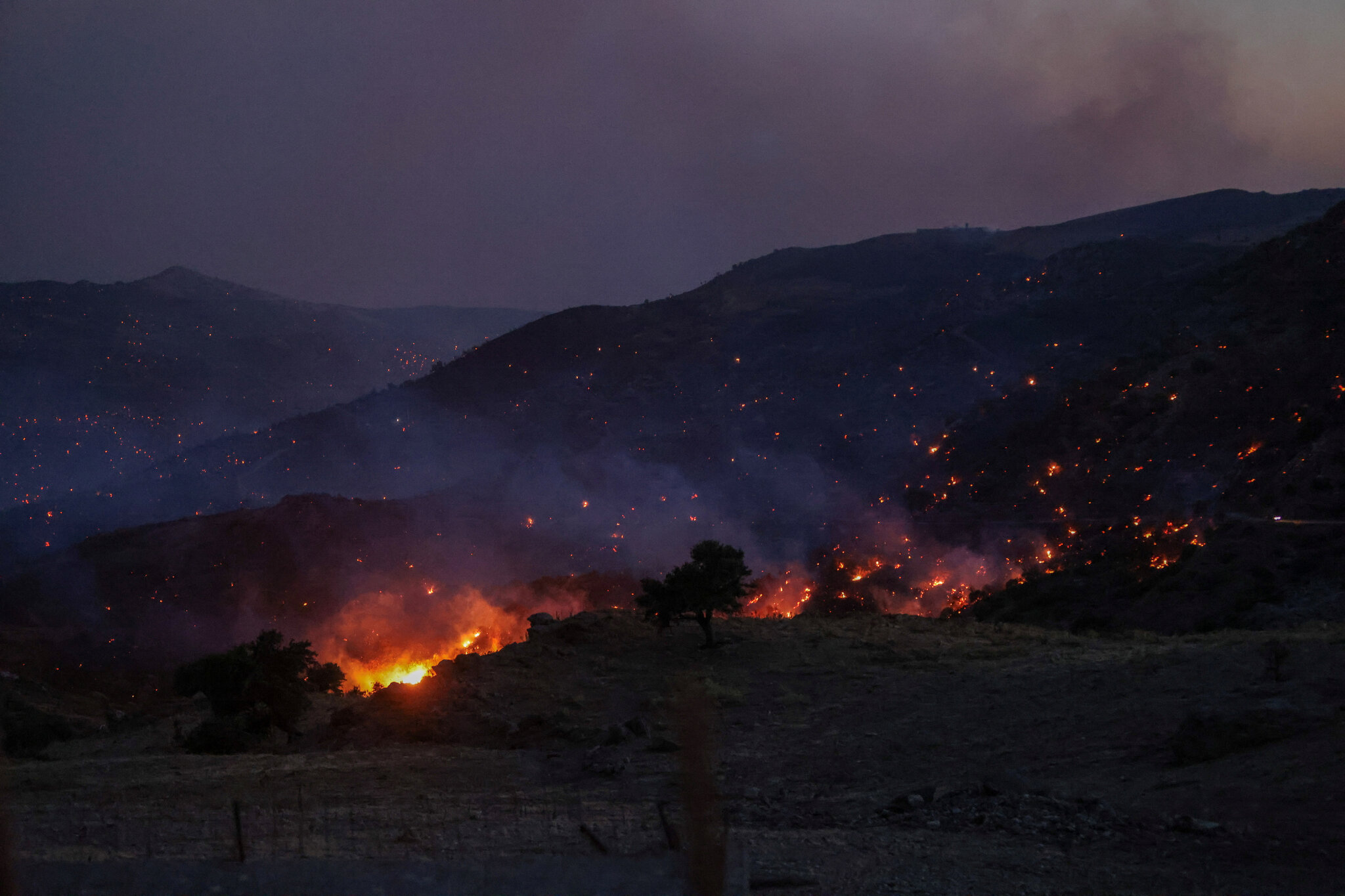
Many of you will have seen the wildfires spreading across Europe in the last few weeks, whether that is in France, Spain, or even Suffolk. In case you haven’t:
France : the fire west of Bordeaux is holding at 42,000 hectares of mostly pine and has not spread for three days, though the interior minister is careful to call it stabilised rather than contained .
Spain: downgraded the emergency level on the largest fire it has ever recorded while ten others still concern it. Three Greek firefighters died on Wednesday.
UK: A heathland fire in Suffolk has put a major incident in place next to the Sizewell nuclear stations .
This week, we put these fires into context and look at what is trying to be done to mitigate the harms. We’re actively looking at companies in the space so do reach out if you’re building here 👋
Putting the fires into context: how this compares to historic wildfires
Source: The Guardian
Temperatures across Europe have been abnormally warm, although this is not a new trend. In June 2026, temperatures were +3C warmer than the 1990-2020 baseline.
Source: The Guardian
The Guardian has a visual guide to the wildfires, which plots the ‘cohorted’ areas burned across France and Spain. Above we can see that France is very ahead of the 2006-25 cumulative areas burned in 2026 relative to the historical baseline.
Source: The Guardian
Spain shows a similar story although it had a very strong wildfire season in 2022. Note though the absolute difference in the charts on the y-axis - France is almost an order of magnitude smaller than Spain.
Across the EU, EFFIS’s own figures put 254,388 hectares burned across the block, slightly below the 270,449 hectares that had burned by the same date in 2025. To date, 2025 still remains the worst year on record. When looking at the longer-term average, there have been 1,254 fires against a long-term average of 569.
Turning to the UK, 2025 was also the worst year in the record. 48k hectares across 181 fires above 30 hectares, against a previous record of 28,754 in 2019. Britain has already had three heatwaves this summer , the Environment Agency has declared drought in seven areas , and Germany, Cyprus, Romania and France sit furthest above their historical averages this year.
How do these fires start? Often, it’s human-caused French investigators put around 90% of fires down to human activity, whether carelessness or arson. Since late June, more than 260 people have been arrested as wildfire investigations continue (two have been arrested in the Gironne this week). A man suspected of setting about ten fires in the Var has been jailed .
Detection speed, powerline monitoring, ignition-source forensics, camera networks with human review, and the boring work of firebreak maintenance all act on this variable. The Gironde operation is maintaining 160 kilometres of firebreaks as a live containment measure.
Comparing Europe against the rest of the world when it comes to wildfires Northern Australia burned an area three times the size of the United Kingdom in 2023. Los Angeles burned about 23,000 hectares, a four-thousandth of that, and produced what may be the most expensive wildfire event in history. Europe’s entire record season last year burned forty-five times the LA footprint for perhaps a fortieth of the loss.
On a global view however, burned area seems to be steadily falling. The fifth Global Fire Emissions Database puts the average at 774 million hectares a year across 2001 to 2020, declining about 1.2% annually, a cumulative fall of roughly 24% over twenty years. This is mainly due to a reduction in grassland fires. NASA’s satellite record found the same over 1998 to 2015, and a paper in Science put the decline near 25%.
We are actively speaking to companies in the space We are looking at this space and already talking to companies in it. Specifically:
Detection and risk-pricing infrastructure with a commercial buyer, insurers and utilities.
Consumer and clinical respiratory health, and where a reimbursement route is imaginable.
Weather prediction & modelling for both short and long-range forecasting.
If you are building in any of these, or know someone who is, we would like to hear from you 👋
Thanks for reading Eka Ventures Newsletter! Subscribe for free to receive new posts and support my work.

31.7.26
Putting European wildfires into context
Issue 164 l Eka’s Weekly Roundup (31 July 2026)