For the first time since the 1940s (when the global grid was fifty times smaller) low-carbon sources delivered over 40% of the world’s electricity in 2024 . Renewables alone hit 32%, up from 19% at the turn of the century. Solar surged 29% in a single year to generate over 2,000 TWh, a figure that has doubled in just three years. Wind and solar combined (15%) overtook hydropower (14.3%) for the first time. The fossil fuel share of global generation dropped below 60% for the first time in over eight decades.
And yet, global electricity demand grew 4.3% in 2024, the biggest absolute increase ever recorded outside of post-recession rebounds. Heatwaves, data centres, EVs, heat pumps, and air conditioning in emerging economies all pushed demand to over 30,000 TWh for the first time. Clean sources met around 80% of that new demand. They need to meet all of it. Power sector CO₂ emissions still rose, reaching a new record. The transition is real, accelerating, and still not fast enough.
Looking a bit closer, there are a few statistics which better describe what is going on under the hood:
The engine of this shift has a name: solar. For the twentieth consecutive year, it was the world’s fastest-growing electricity source. China alone accounted for 53% of new solar generation in 2024 and produces 80% of the world’s PV modules. The economics are increasingly unanswerable: if Chinese clean tech costs continue to fall at current rates, the case for coal retirement becomes overwhelming by the late 2020s.
That dominance carries a flip side. China controls 60-85% of manufacturing capacity across most clean energy supply chains, and in 2025 introduced new export controls on rare earth elements and battery components. A single country is now the dominant refiner for 19 out of 20 energy-related strategic minerals. The IEA’s latest report finds that this concentration is unlikely to change significantly before the end of the decade.
UK: status update since quitting coal The UK’s electricity story in 2024 can be summed up quickly: renewables generated over half the country’s electricity for the first time, reaching 50.8% of total generation. A decade ago, that figure was around 19%. It also quit coal in October ‘24, which made it the first G7 country to do so.
Wind is now comfortably the UK’s largest single electricity source at 29.5% of generation, with offshore wind (48.9 TWh) and onshore (35.1 TWh) both setting records. Solar hit a record 14.8 TWh, aided by 1.6 GW of new capacity: the most since 2016. And in September 2024, the UK’s last coal plant, Ratcliffe-on-Soar, closed permanently, making the UK the first major economy to exit coal entirely. Fossil fuels dropped to 31.5% of generation (unseen since the 1950s!).
Early 2025 data confirms the trajectory continued: renewables supplied a record 152 TWh (47% of total), solar surged 31%, and wind hit 87 TWh. But nuclear fell to its lowest output in half a century, and gas generation actually rose as coal disappeared and demand ticked up.
The government’s Clean Power 2030 target (i.e. 95% of generation from clean sources) remains pretty ambitious on the current data. Clean sources currently provide around 65%. Offshore wind capacity needs to roughly triple to ~50 GW by 2030, meaning the UK must build more offshore wind in the next five years than it has in the previous twenty.
What’s less visible is the transformation happening beneath the generation numbers: in how that clean power is being used , distributed, and managed.
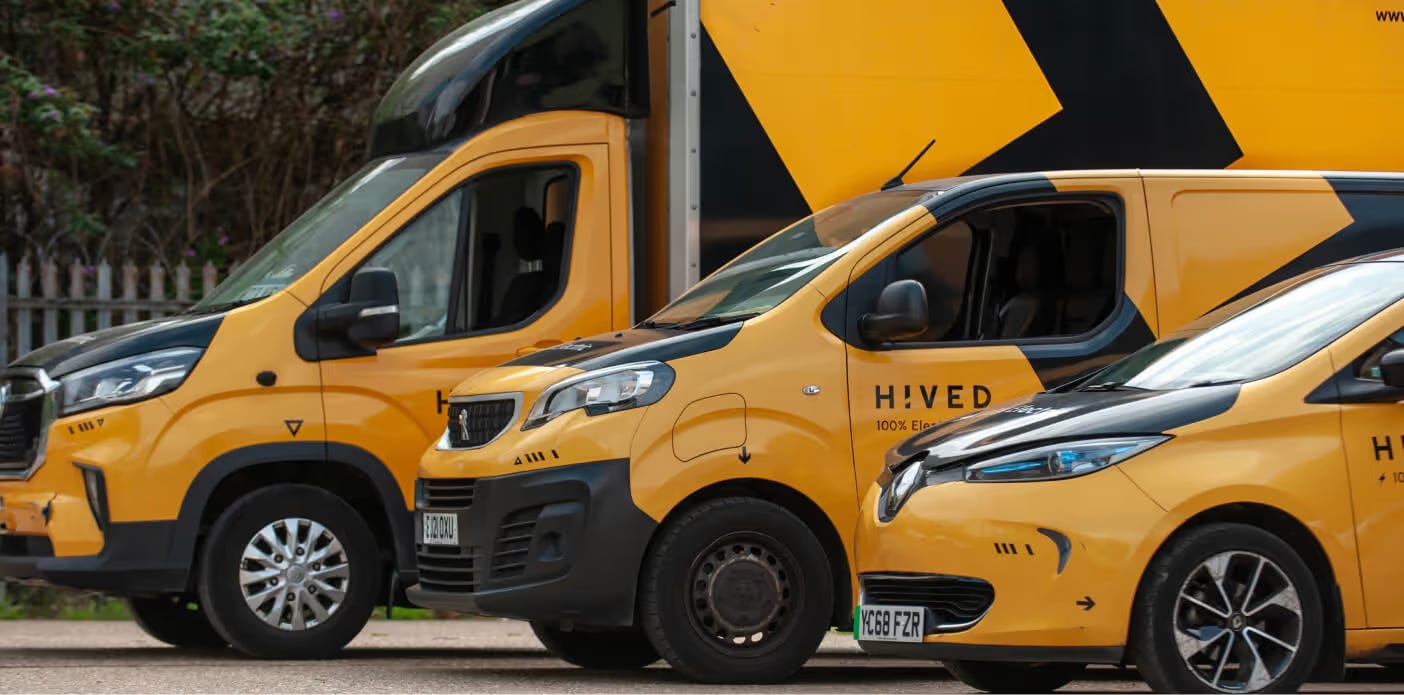
Take logistics. The UK’s parcel delivery sector moves millions of packages daily, overwhelmingly on diesel. HIVED is building the UK’s first fully electric parcel delivery network: not just electric vans for the last mile, but electric HGVs covering intercity routes too, using Mercedes-Benz eActros trucks with 300+ mile range. Since launching in 2021, they’ve delivered over 6.5 million parcels for retailers like John Lewis, Nespresso, and Uniqlo, with a 99% on-time rate. Last year they expanded beyond London to eight new cities, and raised £31m in a Series B to scale nationally. Every HIVED vehicle on the road is new demand on the clean grid: demand that didn’t exist five years ago, and that grows as electrification reaches sectors most people don’t associate with “the energy transition.”
A consumer view: how people are thinking about EVs and home batteries Here’s a set of numbers that should change how you think about the UK’s energy system.
In 2025, 473,348 battery electric vehicles were registered in the UK - a 24% increase over 2024, pushing EV market share to 23% of all new car sales. In December alone, BEVs accounted for over 32% of registrations, comfortably exceeding the government’s ZEV mandate target. Electrified vehicles as a whole (BEVs, plug-in hybrids, and hybrids) now represent close to half of all new car sales. There are now close to 2m fully electric cars on UK roads (around 34m total cars).
But it’s not just cars. In the first half of 2025 alone, UK homes installed almost 20,000 battery storage systems, a 130% increase on the same period the year before. Over 30% of new solar PV installations now come paired with a battery, up from 10% five years ago. Heat pump installations hit 30,000 in H1 2025, up 12%. In total, a renewable energy system was installed in a UK home every 90 seconds in 2025.
At grid scale, the story is equally dramatic. UK operational battery storage capacity has grown 509% since 2020, from around 1.1 GW to 6.9 GW. Over 4 GWh came online in 2025 alone, a 30% increase on the previous year. There are 130 GWh of approved projects in the pipeline.
Axle Energy is building what amounts to an operating system for this distributed grid: a platform that connects EV chargers, home batteries, and heat pumps to electricity markets, automatically dispatching them based on real-time grid conditions, energy prices, and household needs. They’ve partnered with GivEnergy, the UK’s top-selling battery storage company, and Pod Point, one of the UK’s largest EV charging networks (200,000+ chargers sold). In just two years since founding, they’ve connected to over 100,000 devices and managing 1GW of flex.
The model is elegant: a homeowner with solar panels, a GivEnergy battery, and an EV charger managed by Axle’s platform can earn money by allowing their battery to support the grid during peak demand, while the software ensures their household needs are always met first. During the coldest winter days, when the grid is under maximum strain, thousands of these batteries can collectively keep gas peakers offline. Crucially, it’s also the kind of infrastructure that gets more valuable as it gets bigger: every new device added to the network makes the whole system smarter and more flexible.
What changes next? Three dynamics will define the next five years of the UK and global power transition:
The demand shock is real, and it’s accelerating. Global electricity demand is forecast to grow 3.3–3.7% annually through 2026: roughly double the pace of the previous decade. Data centres, AI training, EVs, and heat pumps are all structurally additive. In the UK, the National Grid ESO projects electricity demand could increase 50% by 2035. Paradoxically, this demand surge could accelerate clean deployment. For example, tech companies are signing massive power purchase agreements for renewables, and AI-driven demand may be the thing that finally makes both sides of the political spectrum pro-clean energy.
Storage is the unlock. The countries and systems that crack storage, at grid scale and behind the meter, will be the ones that achieve high renewable penetrations without reliability concerns. Germany’s battery capacity tripled in two years. The UK added 4 GWh in 2025 alone with 130 GWh in the pipeline. The combination of cheap solar, cheap batteries, and smart software to orchestrate them is becoming the dominant energy paradigm faster than most forecasts assumed even two years ago.
Nuclear makes a comeback? France, with 67% nuclear and a carbon intensity six times lower than Germany’s, is the quiet counterargument to renewables-only strategies. The UK’s ageing nuclear fleet is retiring faster than Hinkley Point C can arrive. The US added its first new reactor in decades. The data is clear: countries with both renewables and nuclear consistently achieve lower carbon intensity than those relying on one alone. The debate shouldn’t be renewables-versus-nuclear. It should be all-of-the-above-versus-fossil-fuels.
Energy sovereignty is becoming energy policy. The geopolitics of energy is shifting from who controls oil to who controls the supply chains for panels, batteries, and critical minerals. Europe’s Net-Zero Industry Act aims to manufacture at least 40% of key clean technologies domestically by 2030. The US Inflation Reduction Act was motivated in part by challenging China’s position in clean tech supply chains. India is rolling out incentives for domestic solar manufacturing. The IEA’s 2026 ministerial summit identified supply chain resilience and critical minerals security as top priorities. For the UK, which imports nearly all of its solar panels and a large share of its battery cells, the question is whether “energy independence” can mean anything if the hardware comes from a single supplier. Countries that build domestic manufacturing and diversify mineral sourcing will be better insulated; those that don’t may simply swap one form of energy dependence for another.
Further reading for the curious Further reading on energy geopolitics:
IEA, *Energy Technology Perspectives 2026 :* sourced above, the definitive supply-chain-by-supply-chain analysis of where clean tech is made and what happens if the largest supplier is removed from the market (and pretty freshly published!).
World Economic Forum, “Global energy in 2026: Growth, resilience and competition” : a concise overview of how industrial policy, not just climate policy, is now driving the transition.
Atlantic Council, “The future of energy geopolitics is written in patents” : on why technological capability, not resource ownership, increasingly determines geopolitical relevance in energy.

7.4.26
40% of global power is now renewable
Issue 153 l Eka’s Weekly Roundup (7 April 2026)


Read more articles